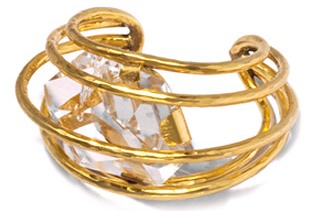
I was recently looking at a few Herve Van Der Straeten furniture pieces for a client. I've always known of Van Der Straeten strictly as a designer of furniture and lighting so was surprised to learn that, prior, he was a jewelry designer. It makes sense now that I think about it-- his furniture and lighting looks like jewelry on steroids! Van Der Straeten himself says that his jewelry designs are a laboratory for studying shapes for future furniture and lighting. Van Der Staeten is not the only designer who has had success expanding beyond one discipline. Frank Gehry's jewelry line with Tiffany is another example of this. In the end, form, proportion, line and scale are elements of all design - from the macro level of a building to the micro level of a pair of earrings. I just find it fascinating when the connection reads so clear like it does in much of Van Der Straeten's work.
7/24/10
7/20/10
Alec Soth vs. Little Brown and Co.
In general, I’m fairly lenient on appropriation. After all, no one works in a vacuum and it’s impossible to have a completely original idea anymore. But my tolerance dissipates when the act of drawing inspiration from a source becomes flat out plagiarism. The most recent example of this in the art world is the blatant stealing of Alec Soth’s photograph Peter’s Houseboat for the Winter’s Bone book cover. Apparently the publisher (Little Brown and Co.) asked Soth for the rights to the image, but he said no when they wanted to Photoshop in the girl. Unsatisfied, the publisher decided to knock off the image anyway. I feel for Soth who didn’t make a dime out of this, but mostly I'm embarrassed for Little Brown and Co. With just a little creativity, they could have staged a new image that captures the “spirit” of Soth’s photograph instead of recreating a barefaced rip off.
7/17/10
Controversy @ MoMA
One of the Museum of Modern Art’s most recent acquisitions to their collection is not an actual object. It’s a symbol: @. At first I was as annoyed with the news as those who publicly described it as “intellectual garbage” and “pretentious nonsense.” But upon further thought, I actually commend MoMA for continuing their long history of being a farsighted institution that sees (or is it more accurate to say “invents”?) trends while the rest of the world is still hung up on more traditional ideas of art and design. It’s not as if the idea of collecting the intangible is really all that new. MoMA has been practicing this for decades. How is the acquisition of the @ symbol any different from a museum purchasing a Sol Lewitt wall drawing from the 1970s? With a Lewitt drawing, all a museum is essentially buying is a set of directions that a museum prep crew uses to materialize Lewitt’s vision. For a more recent example, how is this any different from purchasing an equally intangible performance art piece? In light of this digital age, maybe 21st century museums need to get over the idea of a collection actually consisting of objects.
Subscribe to:
Posts (Atom)