2/10/11
The Breslin
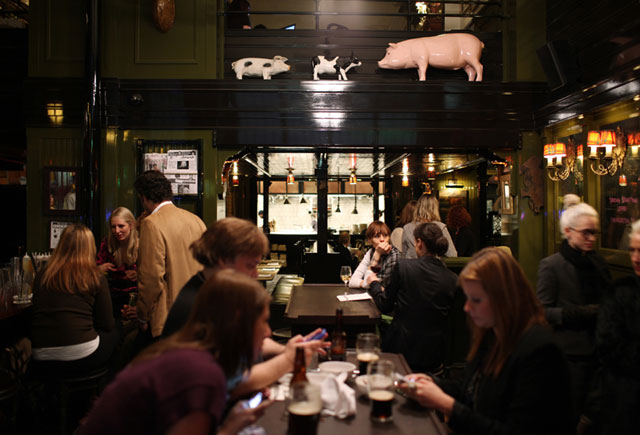
On Monday night, a couple friends and I stopped by The Breslin for an after-work cocktail. We moseyed on up to the bar on the mezzanine level where we drank gin and lavender cocktails, ate “thrice fried chips" and people-watched below. Awesome. But as delicious as the food and drinks (and hipsters) are, the design of the space is even better. The lacquered olive green walls, plaid accents, and animal tchotchkes are incredibly charming and make you feel as if you’ve been transported out of Midtown and into a great, old pub in England. This is absolutely one of my favorite spots in the city.
2/7/11
Mel Ziegler at Cheekwood
![]() |
| Cheekwood Botanical Garden and Museum |
Over the holidays, I visited the Cheekwood Botanical Garden and Museum in Nashville for the first time and was transported to another era by the 55-acre gardens and gorgeous architecture that evokes 18th century England. It’s a real gem that surely is even better in the warmer months. On view was a small show of Mel Ziegler’s work focused on ideas relating to the military and war. My favorite artwork Rock Hard Individualism is a wall sculpture consisting of over a hundred “rock faces” arranged in the shape of the United States. In concept, it reminds me so much of Korean artist Do-Ho Suh’s work. Like Suh’s use of hundreds of military dog tags to create a single shape, Ziegler’s faces could be viewed as both distinct and homogenous. Ultimately, it seems both Suh and Ziegler are challenging the fine line in military culture between strength in numbers and conformity versus individualism. Check out my article in Review Magazine for more of my perspective on the show.
![]() |
| Do-Ho Suh, Some/One |
![]() |
| Mel Ziegler, Rock Hard Individualism |
2/1/11
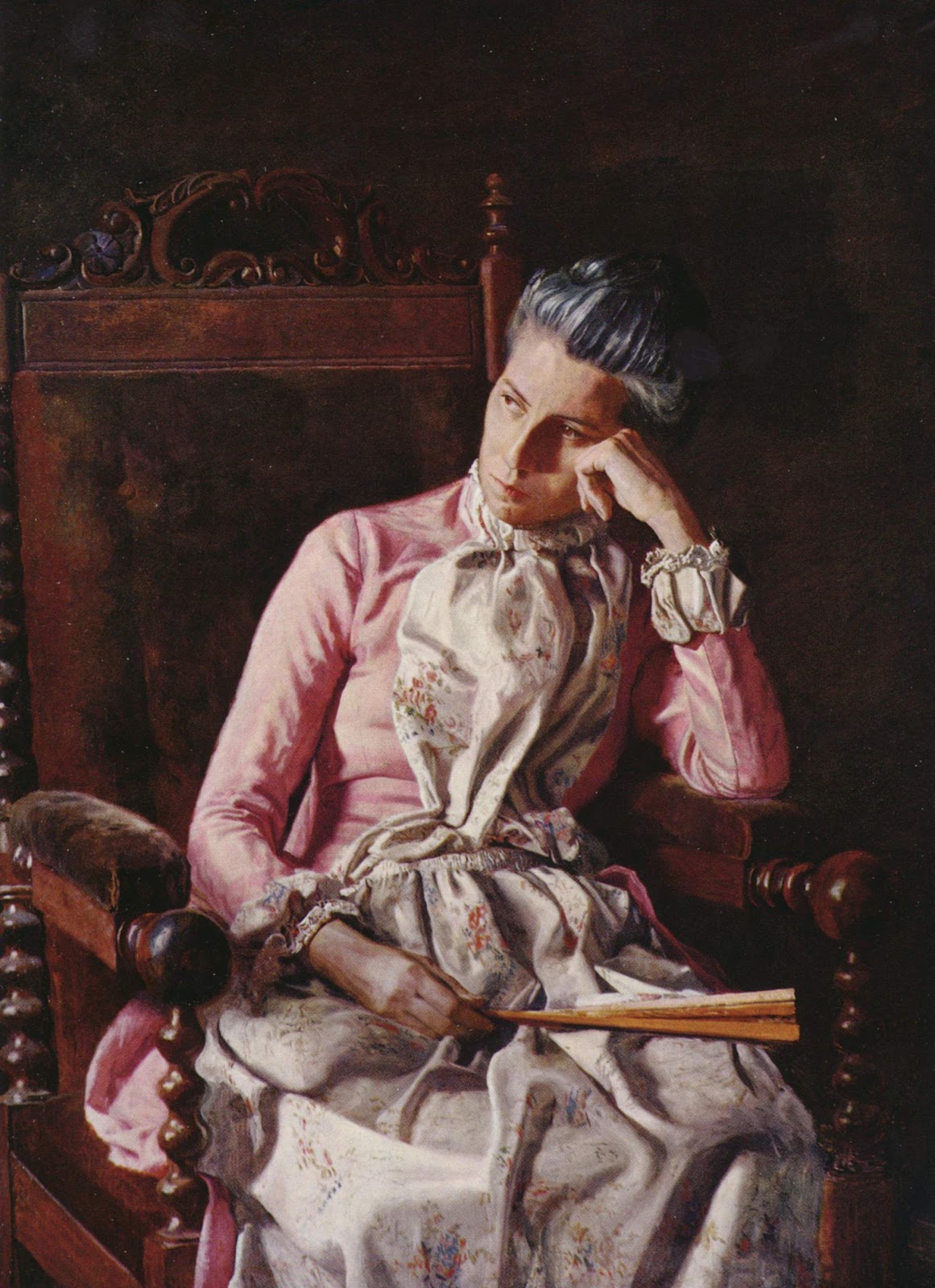
Thomas Eakins' Peculiar Portraits
![]() |
| The Thinker: Portrait of Louis N. Kenton |
![]() | ||
Portrait of Susan MacDowell Eakins
|
1/14/11
I'm confused...
![]() |
| Left: Moore in Harper's Bazaar, Right: Currin, The Cripple |
I don’t understand why magazines are appropriating artwork that critiques the very culture of perfectionism and consumerism they perpetuate. Do they not see the ideas behind Barbara Kruger and John Currin's work as being in direct conflict to the unattainable ideals and superficiality that these magazines (and celebrities) promote? Are these publications more self aware than we give them credit? Or are Kruger and Currin essentially pulling the wool over their eyes?
![]() |
| W Magazine cover w/ Kardashian |
![]() |
| Kruger, Untitled (I Shop Therefore I Am) |
![]() |
| Kruger, Untitled (Your Body is a Battleground) |
1/2/11
Degas Keeping it Real
![]() |
| Degas, The Star, 1878 |
![]() |
| Degas, Dancers Bending Down, 1885 |
I’ve seen two incredible exhibitions recently that have changed my mind about artist Edgar Degas— Birth of Impressionism at the Frist in Nashville and The Modern Woman at the Vancouver Art Gallery. Before these shows, I associated Degas solely with his idealized images of ballerinas above. It always bothered me how he depicted these girls as soft, innocent and sweet when in actuality dancers are tough as nails and their lives can be pretty brutal. So I was surprised to see the Degas paintings below that portray a less glamorous side of life—a girl getting a pedicure that doesn’t exactly look spa-like and an unflattering angle of a woman bathing. These images may not be particularly striking given our standards today, but they were painted at a time when people largely viewed art as an escape from banality. Flowers, seascapes and haystacks were popular subjects, not reminders of mundane daily life.
![]() |
| Degas, The Tub, 1886 |
![]() |
| Degas, The Pedicure, 1873 |
12/31/10
Black Swan and Rodarte
At first I was surprised to learn that Rodarte had designed the costumes and hairpieces for Black Swan, but after finding out how the sisters got their start in fashion, it makes perfect sense. I read an interview given by Natalie Portman where the two sisters talked about how after college they scrapped the biology and art history degrees they had just earned and moved back home to live with their parents. They spent that entire year watching horror film after horror film in order to develop their taste and vision for Rodarte. The costumes in Black Swan are phenomenal, but my favorite creation is the Black Swan headpiece (shown above) made out of metal daggers, thorns, spikes, and don't forget the Swarovski crystals!
Click here to read the entire, super-entertaining interview with the designers.
12/18/10
Overrated Design
![]() |
| The Bouroullec's Ovale Collection for Alessi |
Lately I’ve been reading a lot about Ronan and Erwan Bouroullec’s new tableware line for Alessi. It’s being touted on many blogs and in magazines for its clean lines and simple design and I think all the hype is a little ridiculous. To me, the “collection” looks nice, but ultimately pretty ordinary. I don’t mean to pick on the Bouroullec brothers— it’s a trend happening to many designers today who are getting too many accolades for standard work. Don’t get me wrong, I would rather have everyone jazzed about the latest fork on the market than for good design to go unrecognized, but think perhaps the pendulum has swung too far. I remember not too long ago when most of us bought our toasters from Kmart and didn’t know or care about the designer. I’m glad there is an awareness of industrial design today, but also don’t think every single thing created deserves the level of worship that has become expected today. Is Jasper Morrison’s spoon really better than the no-name spoon I currently have in my drawer? Believe me, I appreciate good design and the small details that separate good from bad, but I’m going to revolt if I read one more profile about the hot new chair that looks just like the new hot chair from 30 years ago and countless subsequent chairs! I want to hear about actual innovation. Where do you stand on this issue?
![]() |
| Jasper Morrison tableware |
12/13/10
Coming back around to Monet
Claude Monet is a good example of what I refer to as a 360-degree artist. Future art historians first go into the field loving his work, then start to lose enthusiasm upon discovering many other great (less commercial) artists, before coming full circle to appreciating his contribution to art history. I reached that last step when I discovered more about his practice of endlessly reproducing the same image in order to “get it right,” which in Monet’s case meant perfectly capturing the light and atmospheric effects of a particular scene. He worked in this obsessive compulsive way throughout his career and you can see it in his multiple series, such as the 15 paintings of haystacks he made between 1890-91, the 31 paintings of the Rouen Cathedral between 1892-94 and the numerous Water Lily paintings created throughout his lifetime. These are works we’ve all seen endlessly reproduced on mouse pads, key chains and mugs so it’s easy to brush them off simply as pretty pictures. It’s more interesting to think of these works as they really were—exercises for Monet to hone his craft. Understanding more the attention, tenacity, rigor and discipline that went into his work makes me appreciate him on a deeper level. Many artists work in series, but for them it often means creating a diverse body of work united by the same theme. For Monet it meant recreating virtually the same image over and over again. This couldn’t have been fun or exciting in the traditional sense, but I get the sense that for Monet art was more about work than play. Realizing that made me see his lighthearted subject matter in a new way and ultimately come back around to liking Monet again.
12/9/10
Nancy Drew and the 1988 Seoul Games
![]() |
| Elena Shushunova |
![]() |
| Daniela Silivas |
I was enthusiastic about many things when I was a kid—Kraft singles, fruit roll ups, Wrinkles dolls, Sweet Valley High—but two things particularly fascinated me:
No history book could make the effects of the Cold War as real to me (at that time, of course) as the sport of gymnastics. By 1988 the Soviets had a long legacy of dominating in the sport and it continued that year with Elena Shushunova’s victory over Daniela Silivas of Romania, as well as the Soviet Union's win in the team event over Romania. I didn’t realize it at the time but Seoul was the last Olympics before the dissolution of the Soviet Union into many separate counties. When the Barcelona games came around in 1992, things were different. The best gymnasts of the Soviet Union were now competing for as many as 15 different countries. Although that paved the way for the Americans to make a name for themselves, I really felt sad for the former Soviets who sacrificed so much for their sport and were under an insane amount of pressure from the government and their families to not just medal, but get the GOLD.
Around the same time I read Captive Witness and while I don’t remember the story much at all, the book cover has stayed in my head over 20 years later! I remember it almost verbatim except I swore she was wearing a swim cap to match her black wetsuit in my childhood version. There’s something about that image of Nancy at night, in the water, while a guard keeps watch, that really creeped me out and gave me additional context (as ridiculous as that sounds) for the bleak life of the Soviet gymnasts at that time. 11/24/10
Holiday Gifts: Idea #1
Unfortunately, I'm in holiday shopping mode. Despite the grueling nature of attempting to locate the most perfect, thoughtful gift ever, there are times when you find a cool new product out there and shopping actually becomes kind of fun. One such discovery are the Harry Allen beeswax bulb candles above. At only $24 for a set of two, they make a great gift for someone who is otherwise impossible to satisfy.
11/16/10
Adaptation #2: Martha Rosler
11/14/10
Adaptation: Jeff Wall
Ever since the exhibition Adaptation has been on view at Philbrook I've been seeing various adaptations everywhere. It’s like when you get a new car and suddenly you notice how many other people in the world also have Toyota Scions. The show at Philbrook features four contemporary artists who have adapted various source materials—book, film, ballet, painting— into new work. But the show could have easily included a hundred other contemporary artists who also utilize the practice of adaptation to create art. Just today I was reading a book that featured an adaptation by contemporary photographer Jeff Wall. See how you think the original compares to Wall’s version.
![]() |
| Hokusai, Caught by the Ejiri Wind, 1831-3. |
![]() |
| Wall, A Sudden Gust of Wind (After Hokusai), 1993. |
11/7/10
Choreographer Hofesh Shechter
Yesterday I caught a performance of Cedar Lake Contemporary Ballet at the Joyce. As always with this company, the program was well-executed and thoughtful, but the standout piece was Israeli choreographer Hofesh Shechter's "The Fools." This ballet was a New York premier - expanded and tweaked from the original commission set on Bern Ballet in 2008. "The Fools" opens with eight dancers (the Shadows) dressed in gray, military-like garb and violently thrashing their bodies up and down to percussive music. This scene repeats throughout the piece abruptly beginning and ending with black-outs and lights. From that point on, you're in for an unsettling 15 minutes. Seven other dancers appear (presumably the Fools) and their movements are hunched and pained. Their stiff bodies and other-worldly claw-like arms and legs convulse as if being electrocuted.
If it sounds crazy, you got it. I've never seen anything quite this raw, grotesque and powerful. I wasn't able to find a video online of "The Fools," but to get an idea of Shechter's unique voice and vocabulary, check out this video HERE of another ballet "Uprising."
10/31/10
Eerie Art: Cattelan's HIM
In honor of Halloween, I thought I would write about the scariest artwork I've seen -- Maurizio Cattelan's HIM. I first encountered the sculpture at the Museum of Contemporary Art in Chicago and it was a jarring experience. The work is meant to be approached from behind so when I first peeked into the gallery I thought it was a perfectly innocuous sculpture of a sweet, innocent boy. But upon entering further and turning around to look closer at the boy, I was surprised to see the adult face of Hitler. It's not clear whether he is praying, begging for forgiveness, contrite or steely-eyed. Cattelan's combination of man/boy qualities in this sculpture too make me wonder whether nature or nurture is more to blame for evil. It's a powerful experience that raises a lot of questions for me. What do you think? What's the scariest artwork you've seen?
10/24/10
Apartamento Magazine
I'm dying to get my hands on an issue of Apartamento magazine. It's a relatively new, Milan-based mag that has a pretty interesting take on how a shelter mag should look and feel. Instead of featuring the mostly fussy and staged interiors of an Elle Decor-type spread, Apartamento takes informal shots of real peoples homes as they are on an everyday basis. As the editor states, “Apartamento is there to capture the moment in life you start living in your own home and you want it to reflect your own personality." From what I can see, there is a lot of soul in these shoots, and they seem to capture what's missing in how we think about interior design today - that it's less about materialistic aspirations and more about personal expression. Apartamento is a very welcome addition to the shelter magazine line-up out now.
10/23/10
Erwin Wurm and the Red Hot Chili Peppers
References to Austrian artist Erwin Wurm (b. 1954) keep popping up lately. There’s an article about his work in the latest Art News magazine and an excerpt in a book I’m reading called The Participatory Museum. He has a delightful sense of humor and his work reminds me just how fun contemporary art can be and the capacity it has to activate an otherwise staid gallery. I particularly enjoy his One Minute Sculptures, which consist of a variety of everyday objects on a platform (buckets, broomsticks, fake fruit, plastic bottles, even a refrigerator) along with handwritten instructions from Wurm encouraging visitors to use those materials in whatever madcap way they desire to create silly “one minute sculptures.” The project clearly charmed the The Red Hot Chili Peppers too as they pay homage to Wurm in their video Can’t Stop.
Subscribe to:
Posts (Atom)